 Read Aloud
The useful answer
Listen to a saved copy with one review question in mind, note the locations that need work, and revise the original document afterward. Finish with a visual check because speech does not reveal every writing error.
Hearing a draft gives you another way to inspect it
After reading your own essay several times, you may know what each sentence is supposed to say. That familiarity can make the draft feel clearer than it is. Hearing the words in sequence gives you another perspective on the actual text you wrote.
Text to speech can be useful for this pass because you do not have to record a new reading after every revision. You can prepare a copy, choose a consistent voice, and hear how the paragraphs connect. The result is an editing aid, not an automatic judgment of quality.
A fluent voice can still read a weak argument smoothly. A good listening review therefore starts with a question and ends with edits you can explain. It does not stop at deciding whether the audio sounds pleasant.
Keep the original as the authoritative version
Save the essay in your normal writing application before making a listening copy. Give the copy a title that identifies its purpose and date. If you later change a sentence in the reader, do not assume that the change appears in your original document.
For a short essay, pasted text may be enough. For a longer document, a suitable file import can preserve a recognizable structure. The text guide and upcoming DOCX guide explain those routes in Read Aloud.
Check the transferred opening, a middle paragraph, and the final paragraph. A partial copy can lead you to critique an argument that is simply missing a section. Fix input mistakes before treating the listening result as evidence about the writing.
Clean only the formatting artifacts first
Remove accidental line breaks, repeated page headers, or other copy artifacts from the listening version. Preserve real paragraph boundaries and punctuation. The goal is to hear the essay, not the visual mechanics of the page it came from.
Do not make major stylistic edits before the first listen unless you already know they are needed. If you polish everything during preparation, you lose the chance to hear where the original draft actually felt unclear. Keep source cleanup and writing revision as separate decisions.
For examples of careful formatting repair, see cleaning copied text. A line break inside a sentence and a deliberate new paragraph need different treatment.
Pick one question for the first pass
A structural question might be: does the introduction establish the topic before using specialist terms? Does each section have a clear purpose? Does the conclusion follow from what the essay actually showed? Choose one or two questions that match the stage of your draft.
For an early draft, structure usually deserves attention before tiny phrasing choices. There is little value in polishing a sentence inside a paragraph you will remove. Listen for the order of ideas and whether the transitions tell the reader why the next section belongs.
For a later draft, you might focus on repetition or sentence density. Naming the target keeps the review from becoming a vague search for anything that sounds imperfect.
Use a consistent voice and a comfortable pace
Choose a voice you can follow without concentrating on its novelty. Keep it steady across revision passes so changes in the writing are easier to judge. If you change the voice and speed every time, you introduce another variable into the comparison.
Start slowly enough to follow the argument. A rapid skim can conceal a transition that needs work, especially when you already know what comes next. Increase the pace only if the review question still makes sense at that speed.
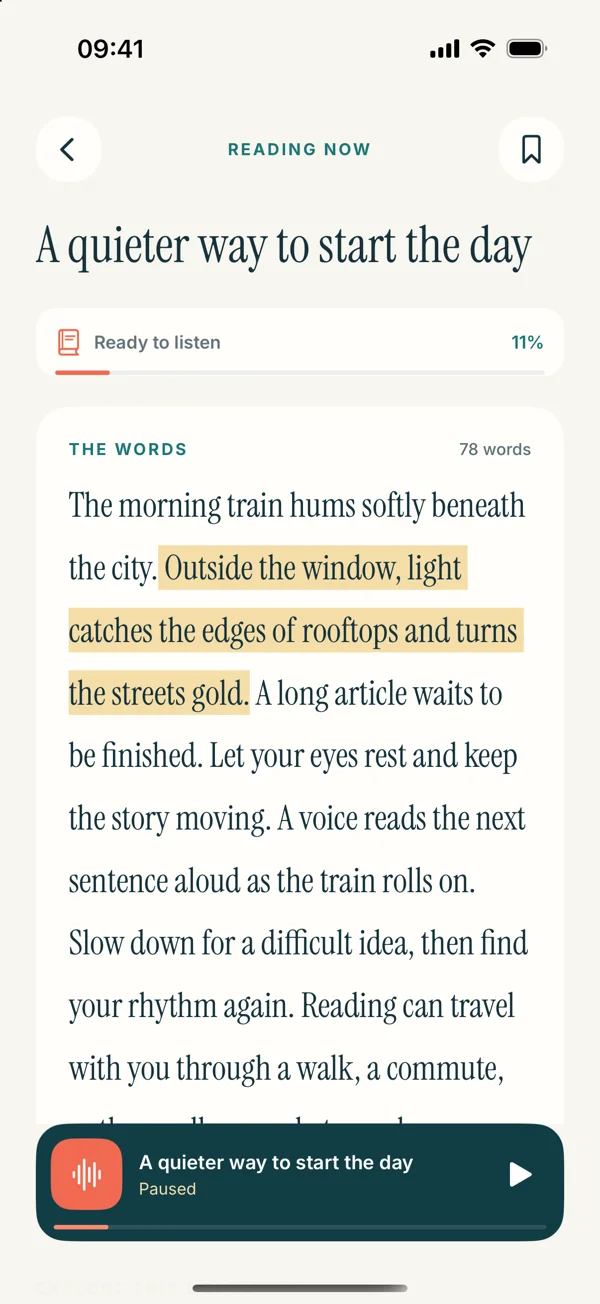
Read Aloud separates system voices from optional paid Plus voices. A system voice is a sensible starting point for testing this workflow. The voice guide explains comparison choices without implying that a paid voice is required for useful editing.
Listen once without repairing every sentence
Let a section play long enough to hear its shape. When something needs work, note a short location marker and the reason: “second paragraph, example before definition” or “conclusion repeats opening without resolving question.” Then keep going if the issue is not blocking comprehension.
Stopping at every repeated word can fragment the review so much that you never hear the essay’s overall movement. Save detailed sentence repair for a later pass. A structural listen and a copy-editing listen are different tasks.
If a passage becomes impossible to follow, pause. Determine whether the problem is source corruption, a missing sentence, unfamiliar terminology, or the writing itself. Do not blame the argument for a broken copy-and-paste result.
A worked example: the missing bridge
Suppose an essay begins with a personal anecdote, then moves directly into a statistical claim. On the page, a heading makes the shift look organized. In audio, the connection feels abrupt because the reader has not been told what the anecdote illustrates.
Mark the transition and return to the original. You might add a sentence explaining the relationship, move the anecdote, or remove it if it does not serve the argument. The right edit depends on the essay’s purpose; the listening pass merely revealed the gap.
After revision, replay the end of the first section and the beginning of the next. You do not need to hear the entire essay again to evaluate that local change. A targeted replay makes the review cycle manageable.
Use a second pass for repetition and sentence load
Once the structure works, listen for phrases that recur without adding meaning. Repetition can be deliberate and useful, so do not remove every repeated term. Ask whether each recurrence clarifies the point or merely fills space.
Notice sentences that require you to hold too many qualifications before reaching the main verb. The answer may be a shorter sentence, a clearer order, or a separate paragraph. It is not always a matter of deleting words; sometimes the sentence needs a more explicit relationship between ideas.
Keep your notes specific enough to guide an edit. “Too long” is less useful than “the exception arrives before the reader knows the rule.” The second note explains why the sentence is difficult to follow.
Listen to quotations and citations differently
Quoted passages and references can interrupt the rhythm, but they may carry essential evidence. Do not remove them from the original simply because they sound awkward. Decide whether the current pass is for prose flow or for source verification.
For a flow pass, you can note a dense reference and continue. For an evidence pass, return to the original citation and check it visually. A speech voice may not make punctuation or formatting errors obvious, and it cannot determine whether a source supports your claim.
If you prepare an excerpt without the reference list for convenience, label it as an excerpt. Keep the complete draft available so the listening version does not become a misleading substitute for the document you will submit.
Know what audio is unlikely to catch
Words with different spellings can sound the same. A missing comma may not produce a noticeable change. A voice may pronounce a misspelled word plausibly, or stumble on a correctly spelled specialist name. Listening is therefore an imperfect test of spelling and punctuation.
Formatting problems, broken links, inconsistent headings, page references, and citation style need visual inspection. Factual claims need source checking. An argument that sounds confident can still rest on weak evidence.
This is why the routine ends with a separate visual pass. Combining perspectives is more useful than expecting one tool to make the essay error-free. No particular number of listens guarantees that every issue has been found.
Apply edits in the original and test the changes
Return to the writing application and make the planned revisions there. Work from your specific notes rather than trying to remember how the whole essay felt. Check that a moved paragraph still fits its new neighbors and that a deleted sentence has not removed necessary context.
Save the revised draft before making a new listening copy. Give the new version a clear label or replace the old working copy deliberately. If you leave several nearly identical items in your library, it becomes easy to replay the wrong one and doubt edits that were never in that copy.
Replay changed passages with the same voice and pace. If a revision improves clarity but introduces another problem, adjust the original again. The listening app is one stage in the editing loop, not the place where the document’s history must live.
Make the final pass visual
Read the finished document on screen or in its intended layout. Check headings, paragraph spacing, quotations, citations, spelling, and any tables or images. Follow important references back to their sources when necessary.
Then compare the final text with the assignment or publishing requirements. A smooth listening experience does not establish that you answered the question, met the length requirement, or included required material. Those are separate checks.
You can keep the last listening copy if it is useful, but label it clearly. The version you submit or share should be the one you actually reviewed and saved in the original editor.
Try the routine on one section
Start with a short introduction or a single body section. Prepare the text, listen with a structural question, note the specific problem, edit the original, and replay the change. That small cycle shows whether listening helps your writing process without turning revision into an elaborate project.
The upcoming Read Aloud interface is described throughout the guides; the current public app is 1.0.2. View Read Aloud on the App Store for current availability and use the matching text or document route.
The point is to hear what you wrote closely enough to make a better decision about it. Keep the source accurate, the review question concrete, and the final judgment with you as the writer.